The Benefits Cliff
How the public benefits system holds women back and what we can do about it
For too many women, working more, earning more, or saving even a little can mean losing the food assistance, health coverage, housing help, or child care support their family depends on. This is the “benefits cliff” — and it traps women in impossible choices between their paycheck and their family’s stability.
At Women’s Money Matters, we see this bind every day in our coaching and financial empowerment work. This page explains what benefits cliffs are, why they hit women hardest, what the data shows, and what policymakers can do to fix it.
What Is a Benefits Cliff?
“Benefits cliff” is a catch-all term for several distinct ways that public benefit rules can punish work and savings:
- A cliff: a small increase in earnings triggers a sudden, large loss of assistance — leaving a family worse off than before.
- A steep phaseout: benefits shrink gradually as earnings rise, but fast enough to absorb most of the financial gain from working more.
- An asset limit: a savings cap that forces families to keep little or nothing set aside in order to stay eligible for benefits.
These dynamics mean a woman can take a promotion, work more hours, or build a small emergency fund — and see little or no improvement in her family’s actual financial position.
Why Do Benefits Cliffs Fall Hardest on Women?
Benefits cliffs are a universal problem in the public benefits system, but they weigh disproportionately on women:
80%
of single parents are women1
~55%
of SNAP and Medicaid participants are women2
83%
of housing voucher households are headed by women3
Women also tend to earn less than men and are more likely to be caregivers for children or older family members — which makes them more likely to rely on the very programs where cliffs and phaseouts are steepest: SNAP, Medicaid/CHIP, housing assistance, and child care subsidies.
“I shouldn’t be punished for accepting a better job for my family, or accepting a raise. I am tired of surviving in this world. I want to live in it.”
What Do the Numbers Show?
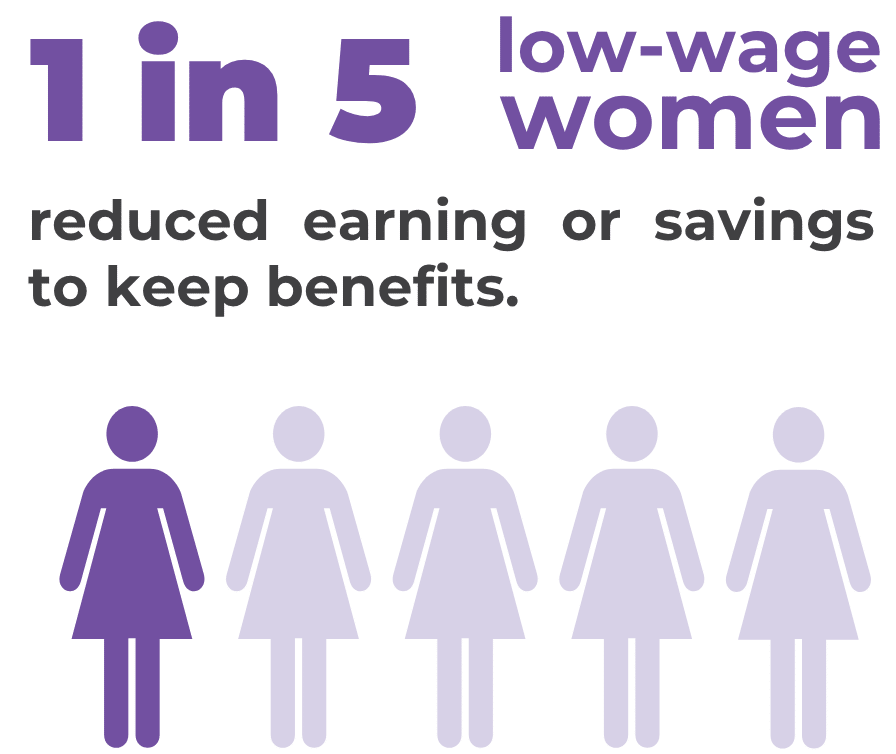
A nationally representative survey of low-wage workers found that roughly one in five low-wage women receiving benefits had taken at least one action to avoid losing their benefits4
10.9%
did not take on additional hours at work
9.7%
changed a family decision, such as not getting married, to protect benefits
8.8%
kept their savings below an asset limit
7.3%
turned down a raise or promotion, or a job offer
For women who turned down extra hours, the most common amount given up was 6 to 10 hours a week — and about half reported losing between $250 and $1,000 in earnings every month as a result.4
"It almost felt like when I was low-income, I didn't have to spend as much on necessities and I could save more. Now I feel like I'm living paycheck to paycheck to cover my expenses."
What Are We Seeing and Hearing at Women's Money Matters?
"I took a job offer and it (the benefits cliff) reduced my snap benefits to almost nothing. We struggled to eat."
"It reduced my housing, SNAP, and SS assistance to the point where I was struggling to pay for gas and lunch to get to work. I was unable to help my son during his last year of college financially; it was just a stressful and unnecessarily difficult time. The result is you are punished for working, work is not truly incentivized or supported no matter how much we pretend it is by existing programs."
Data from women entering WMM’s programs shows just how thin the financial margin is for the families most exposed to these cliffs:
$1,500
median monthly income
$0
median savings
64%
overdraw their bank account at least sometimes
36%
employed full-time
62-63%
lack confidence managing money or asking for a raise
31%
unemployed, homemaker, or retired
Source: WMM client intake data
These numbers don’t prove every WMM client is affected by a benefits cliff directly — but they show exactly the conditions that make cliffs so dangerous: no savings cushion, unstable employment, and low confidence in navigating financial decisions.
Coaching Helps Women See a Way Forward
Data from Leap Fund’s benefits cliff coaching programs shows how much awareness and guidance can change the picture.
Only 28% of women had heard of benefits cliffs before their first coaching session, yet coaches found that 37% of clients were actually at risk of hitting one.5
After coaching:
51%
of women said the coaching changed their decisions about work or benefits
49%
of those affected said coaching helped them take on a new job
18%
said coaching helped them pursue higher wages
7%
said coaching led them to turn down hours or a job
The Takeaway: Most women on benefits want to work more and earn more.
What holds them back is the complexity and risk of the system, not a lack of ambition.
Coaching helps close that gap, but it cannot replace deeper policy fixes.
What Needs to Change
Women’s Money Matters supports policy reforms that reward work and savings instead of penalizing them:
- Replace abrupt cutoffs with gradual phaseouts — so families don’t lose multiple benefits at the same income level.
- Raise income and asset limits — so families can build a modest savings cushion without losing eligibility.
- Provide transitional benefits — temporary support as earnings rise above eligibility thresholds.
- Simplify eligibility rules — align income definitions and reporting requirements across programs.
- Invest in navigation, calculators, and coaching, like the support Women’s Money Matters provides— alongside policy reform, not instead of it.
- Target the programs that matter most to women — child care, housing, and protections against income volatility.
“When I was trying to get back on my feet, I instantly stopped receiving food stamps, my rent went up significantly, and I had to pay more in childcare at the time. So even though I was getting paid only several dollars more, I was paying more in all these other areas, so I was struggling even more to pay my bills.”
Join Us in Closing the Cliff
Women’s Money Matters works directly with women navigating these exact tradeoffs — through financial coaching, peer support, and wraparound services that build both skills and confidence.
We also partner with policymakers and researchers to bring real client data into the policy conversation, because the women closest to this problem should help shape the solutions to it.