Category

Programs & Partnerships

If you are a reporter looking to connect with Women’s Money Matters, please reach out using our Contact Us form.

WMM Testifies for Financial Education

By Programs & Partnerships
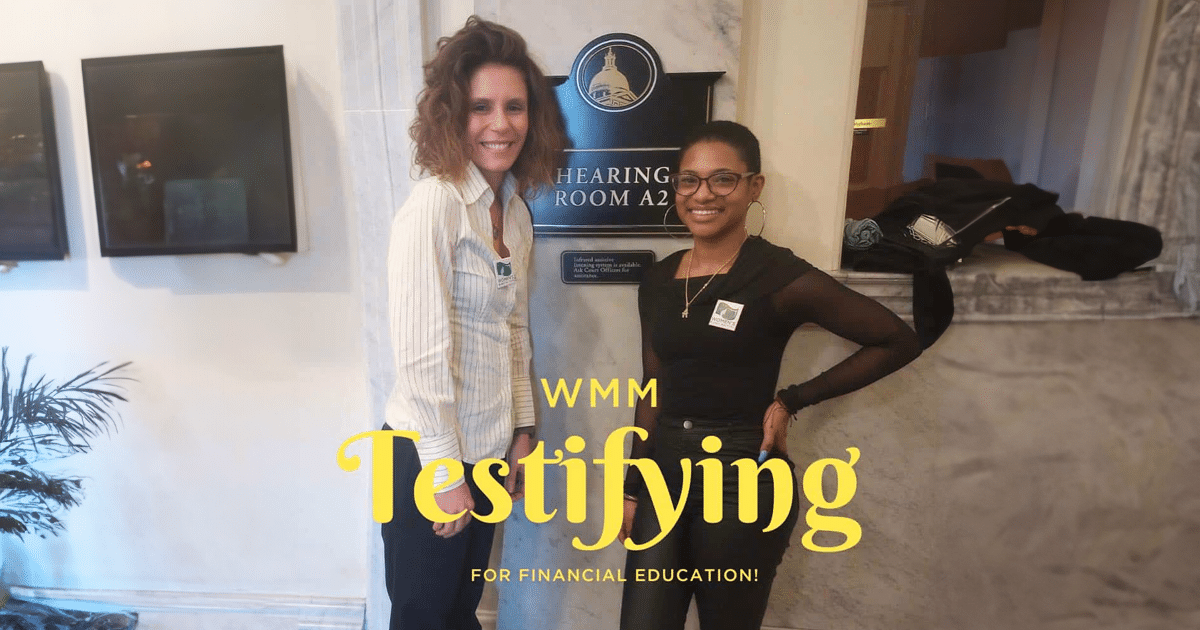
We are so grateful that we were able to testify yesterday at the Massachusetts State House in support of Ryan Hamilton House Bill 4199- An Act Relative to Personal Financial Literacy- that would make one financial education class a graduation requirement! Our Program Manager, Carla, testified alongside a WMM graduate, Ariela Reynoso .
 
Carla testified to the importance of early financial literacy education so that youth are prepared, as they become adults, to be financially secure. Ariela testified as to how WMM helped her improve her credit score and the ability to become financially independent and was interviewed on WBZ NewsRadio

Raising Voices on Pay Equity

By Programs & Partnerships, Advocacy

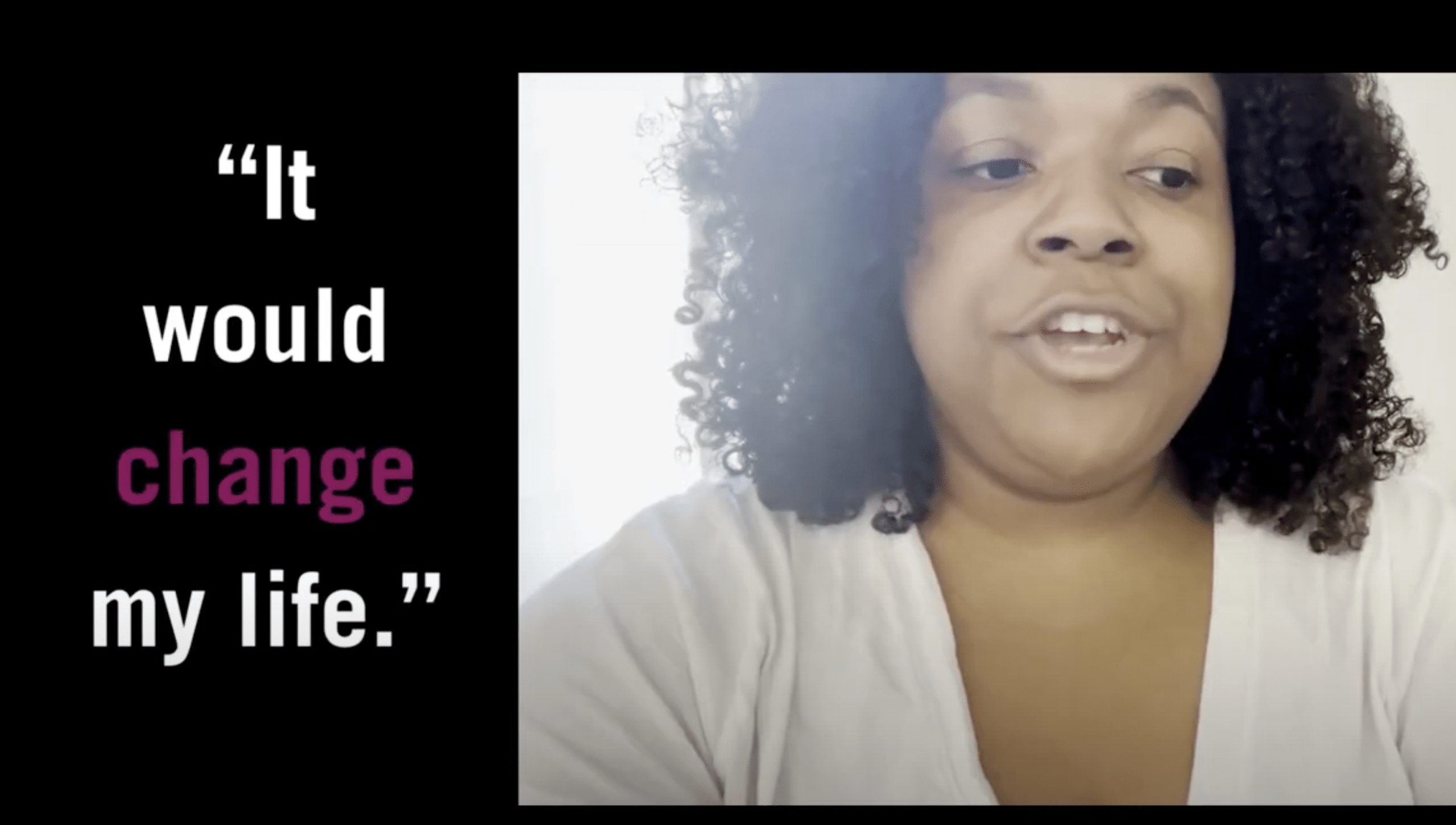
Watch the video here to listen directly to how women’s lives would be drastically improved if the gender wage gap were to close.
Women’s Money Matters empowers women to improve their financial health. We asked women in their financial wellness programs what they would do with an extra 30% income, or $6,592 a year, accounting for the 30¢ average gender wage gap. 

The Boston Women’s Workforce Council (BWWC) leads a unique public-private partnership between the Boston Mayor and Greater Boston employers dedicated to eliminating gender and racial wage gaps. According to the BWWC’s 2021 Gender and Racial Wage Gap Measurement results, collected directly from employer payroll systems, the average gender wage gap in Greater Boston is 30¢.

Women’s Money Matters Opinion on Affirmative Action

By Programs & Partnerships

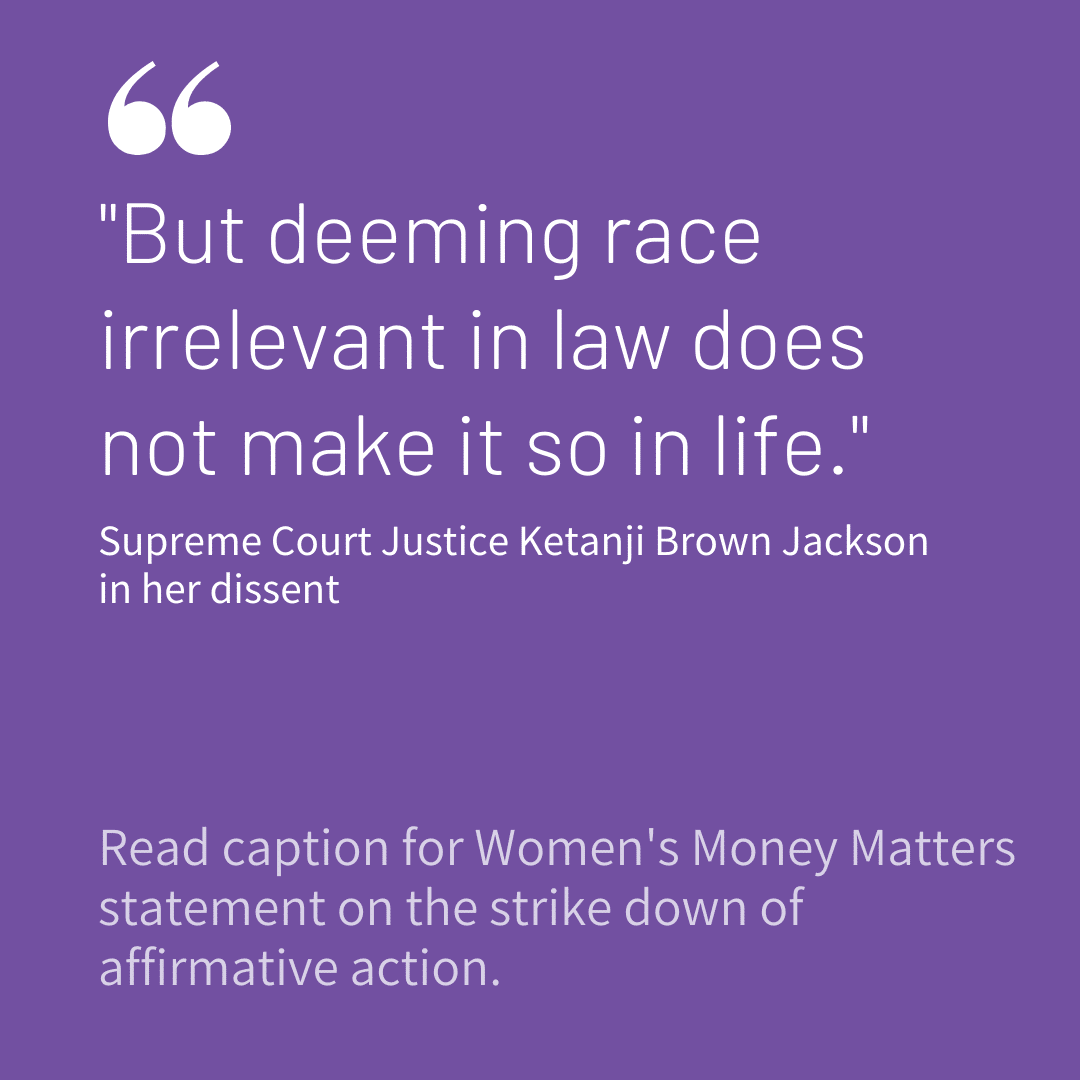
As an organization that advocates for women living on low-incomes, their families, and their communities, we are discouraged, disheartened, and disappointed by The Supreme Court’s decision to strike down affirmative action in college admissions. This decision will negatively affect the already marginalized communities we serve, who are primarily Black, Indigenous, and other People of Color (BIPOC) – communities who  already lack opportunities for economic mobility and generational wealth building. 
Affirmative action is crucial for promoting economic mobility and breaking the cycle of poverty among BIPOC people. Historically, systemic discrimination and inequality have hindered the progress of marginalized communities, particularly people of color. Affirmative action policies aim to level the playing field by providing opportunities and addressing the structural barriers that have perpetuated racial disparities. By increasing access to education, employment, and other resources, affirmative action enables individuals from disadvantaged backgrounds to overcome the obstacles they face and pursue upward mobility.

In the past, by implementing policies that promote diversity and inclusion in educational institutions, affirmative action helped to address historical disadvantages and foster equal access to quality education. This not only enhances the educational experience for all students but also creates pathways for BIPOC people to gain the skills and knowledge necessary for economic success. With improved access to education, individuals from marginalized backgrounds can secure better job opportunities, higher wages, and improved prospects for their future. Thus breaking down barriers and challenging stereotypes, affirmative action can help dismantle the structural inequalities that have hindered the economic progress of BIPOC people, contributing to the overall reduction of poverty rates within these communities.

This decision by the Supreme Court to end affirmative action will end the educational opportunities that have been essential for promoting economic mobility and lifting BIPOC people out of the cycle of poverty. Affirmative action not only benefits individuals but also contributes to a more inclusive and equitable society, where everyone has the chance to thrive and contribute to the nation’s economic growth.  


Gisel Lopez: Insights on Courage and Mentorship in Navigating Life’s Uncertainties

By Programs & Partnerships

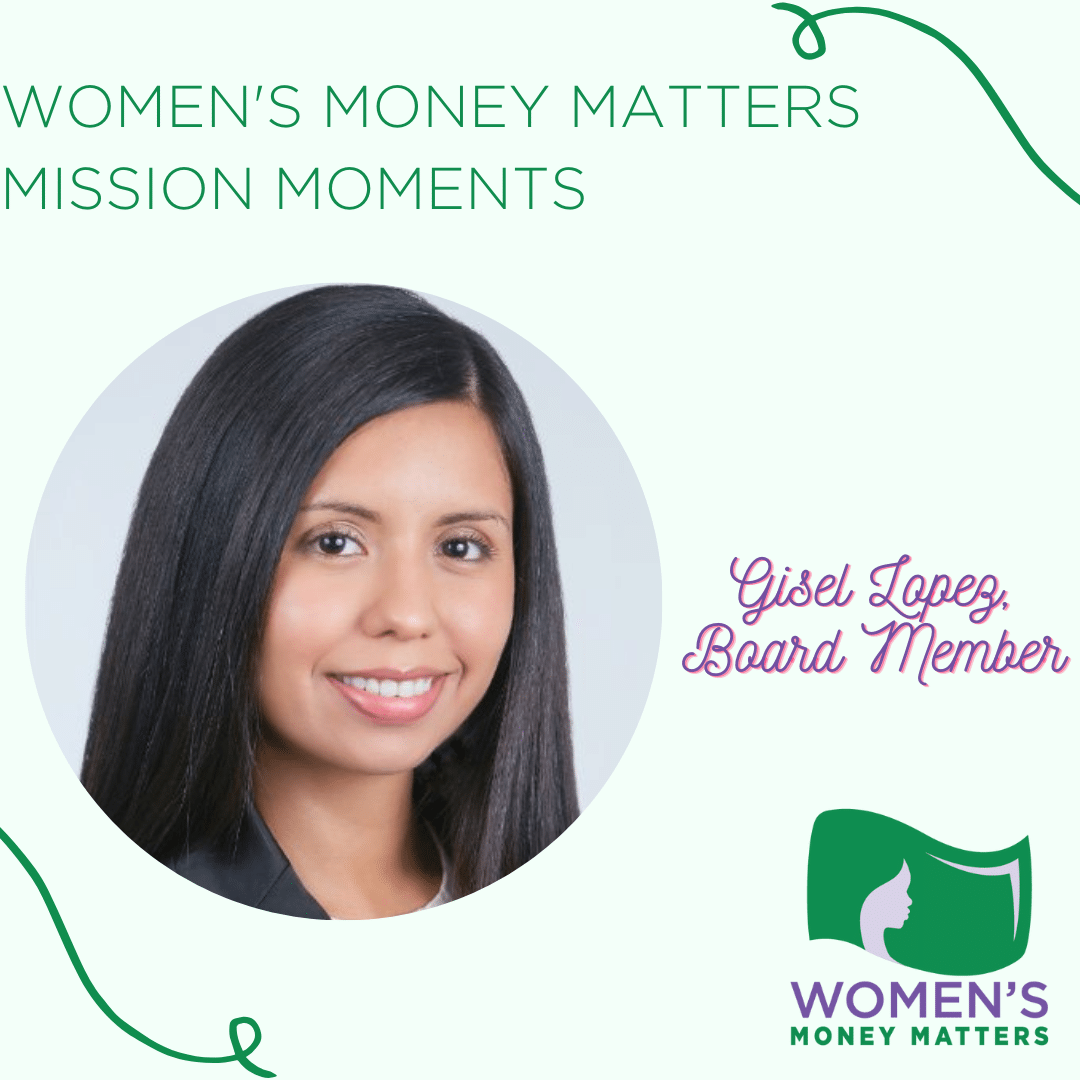
As a successful businesswoman and member of the Women Money Matters’ Board of Directors, Gisel Lopez exudes a quiet confidence and poise. However, it wasn’t all that long ago that Gisel found herself new to the U.S. and uncertain about how to navigate the culture, including how to get her financial footing.
Gisel moved to the U.S. from Peru in 2015. Gisel explains, “I found it difficult to navigate my finances in the U.S. Unlike in Peru, I needed to establish a credit score to be eligible to access credit. Also, I did not understand the different methods to save for retirement and the different terms associated with filing taxes felt confusing.”

Like many, Gisel turned to Google to get some answers. While some of the information online was very helpful, not all of it was relevant, or even necessarily in her best interest. Fortunately, her manager at the time was also an immigrant and guided her with her approach to personal finances. “I was so lucky to have a mentor to answer my financial questions,” said Gisel.“That is why I am so passionate about Women’s Money Matters mission and its coaching model. I truly believe that as an organization we can support women on their journey to financial independence.”

Gisel has witnessed first hand the importance of women achieving financial independence. At 14, Gisel’s parents divorced, and Gisel’s mother no longer had the financial support of her husband. Without a college degree, Gisel’s mother had to be creative about how she’d support her children. They moved in with Gisel’s grandparents and her mother began selling things door to door. It was a much different life than they’d had before. However, with a lot of hard work, Gisel’s mother later went on to become a successful realtor and now she managed her own properties.  “My Mom showed such tremendous courage as she began a new life for us,” said Gisel. “Even though it wasn’t easy, we are all stronger than we think.”

When asked what advice she’d give to others, Gisel shared, “Find a community that has your best interest at heart. Every day we are faced with different and often difficult decisions and having a community makes it so much easier.”

Women’s Money Matters Graduate Speaks on the Impact of Cliff Effects

By Programs & Partnerships

PRESS RELEASE

For Immediate Release:

December 6, 2022
Media Contacts: Ariana Contreras

(acontreras@womensmoneymatters.org)

520-456-5965

Women’s Money Matters Graduate Speaks on the Impact of Cliff Effects

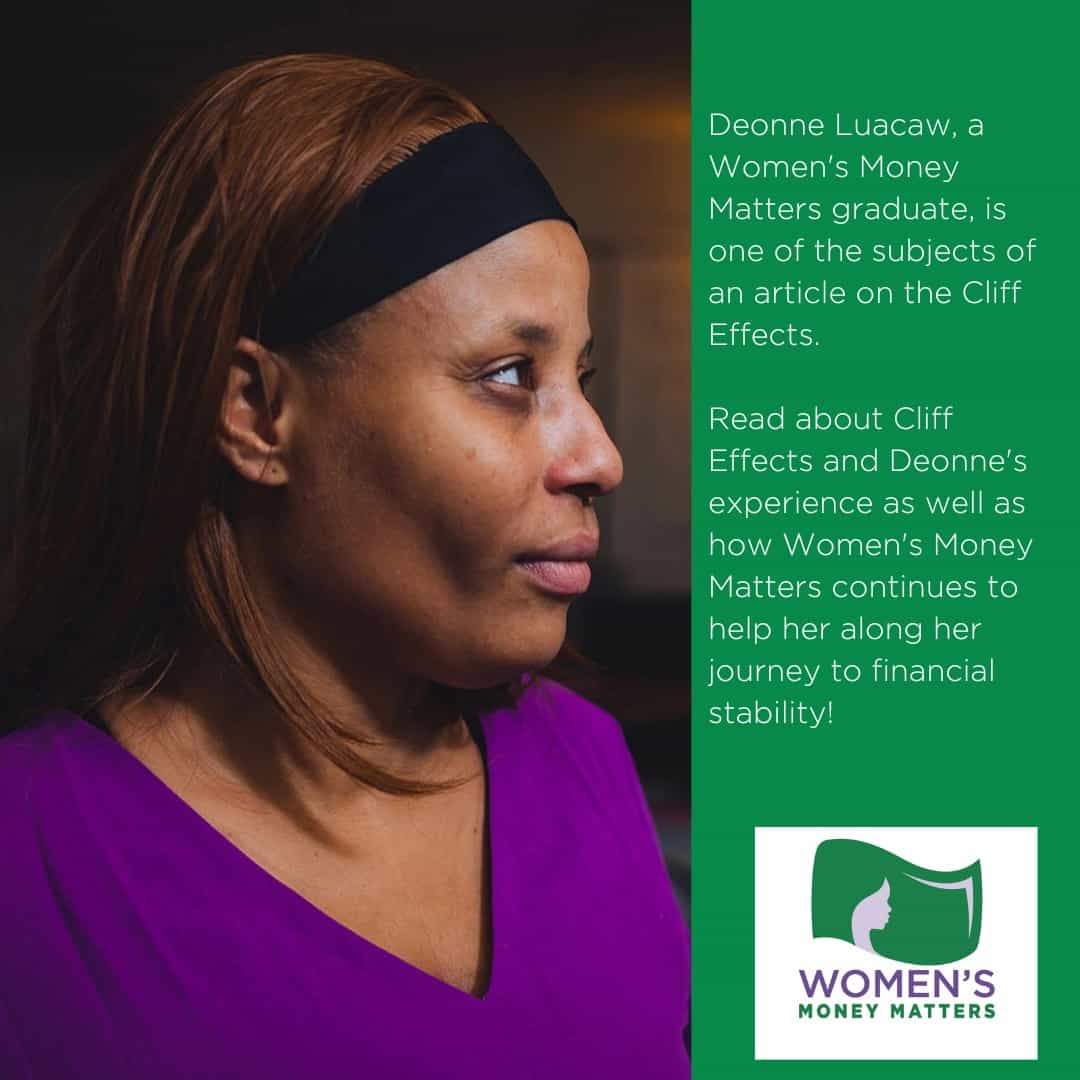
Deonne Luacaw spoke on the impact the cliff effect has had on her finances and employment. 


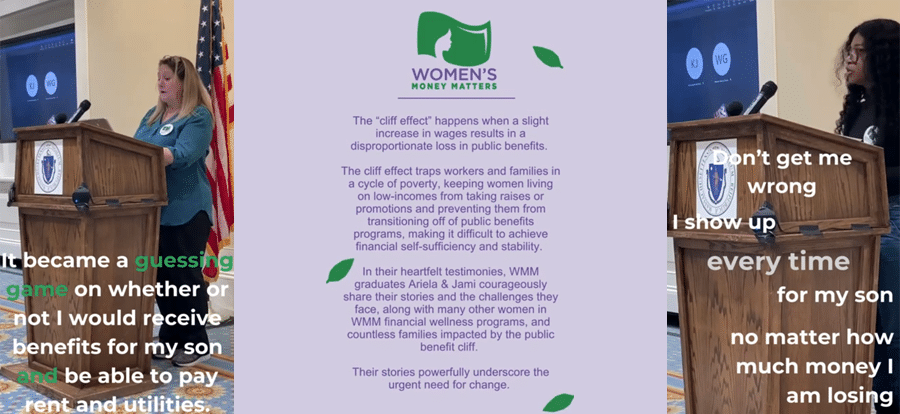
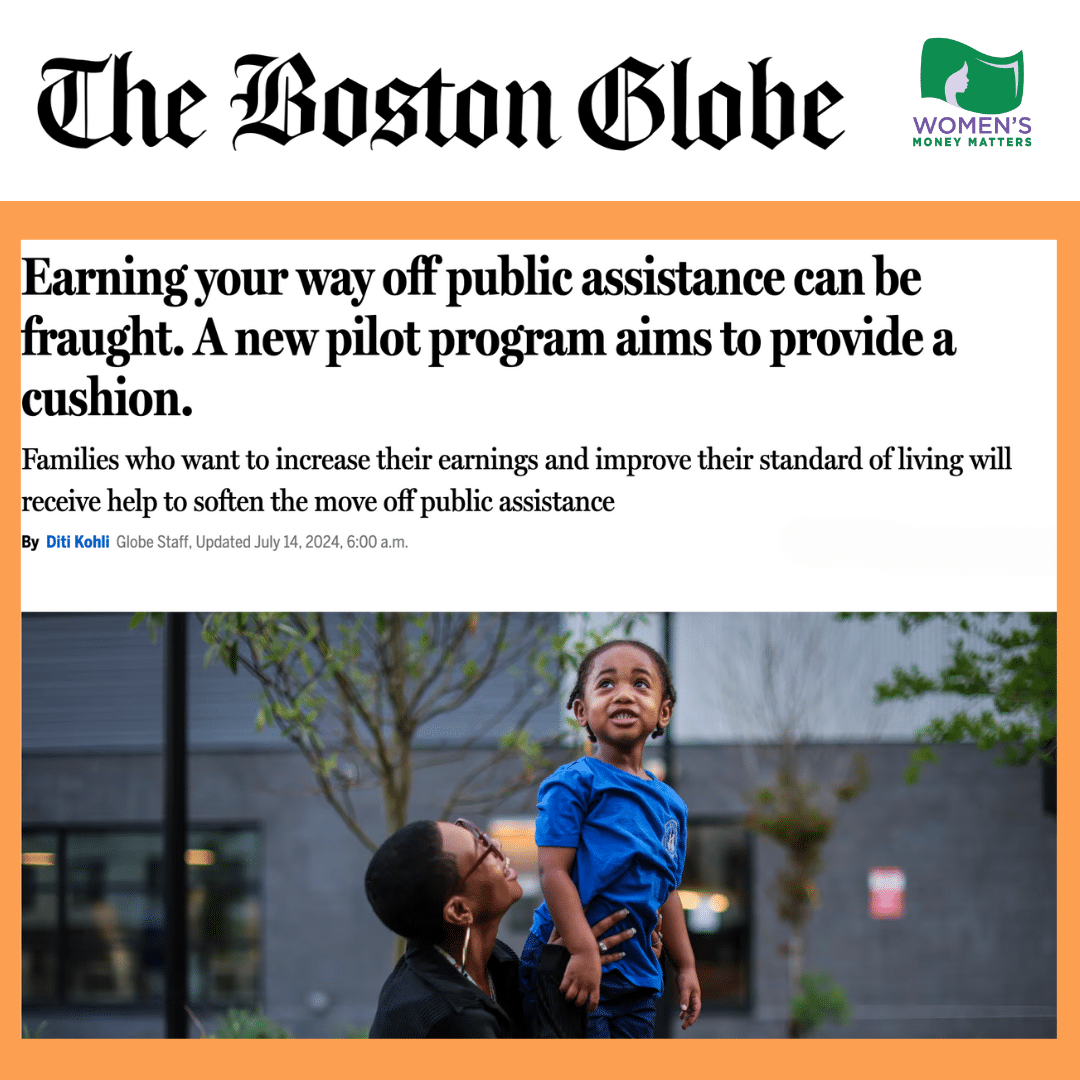
Women’s Money Matters, formerly Budget Buddies, which builds the financial wellness, confidence, and security of women living on low-incomes, connected program graduate Deonne Luacaw to be featured in an article by Fed Communities about the economic cliff effects. The cliff effect is the gap between what someone will be earning in a new job and the value of the public assistance benefits that person loses as a result. The cut off for benefits is often lower than the income needed to earn to replace that benefit. 


Danielle Piskadlo, Executive Director of Women’s Money Matters, on the cliff effects “In our financial wellness programs our participants frequently share their struggles with the cliff effect and that they have the desire to enter the workforce or seek better paying jobs. However when they increase their incomes they can’t afford childcare costs, it will change the amount of their housing vouchers and increase their rent, plus the loss of food assistance would be difficult due to the rising costs of essentials like groceries.”


Due to the cliff effect, people like Luacaw who get financial support from public assistance can end up worse off after joining the workforce, accepting a pay raise or promotion, or moving to a better-paying job. Luacaw shared, “We’re going to write out my goals, how much I can put into savings, when to pay my rent—these are the priorities. Before [Women’s Money Matters], I was never paying my bills on time. Now, I have steps. I have a calendar with reminders, just to anticipate these things. I never had a checking account. They helped me navigate through that. It’s these things that I wasn’t taught. I was just trying to survive.”

Read the full article here

# # #

About Women’s Money Matters:

Women’s Money Matters, formerly Budget Buddies, builds the financial wellness, confidence, and security of women living on low-incomes through a unique program that combines instructional workshops and personal, one-to-one coaching.

About Fed Communities 

Through applied research, public programs, outreach and technical assistance, Federal Reserve community development teams help promote economic growth and financial stability in low- and moderate-income communities across the country.

Women’s Money Matters Graduate Speaks on Inflation’s Impact on NBC Nightly News 

By In The News, Programs & Partnerships

Women’s Money Matters Graduate Speaks on Inflation’s Impact on NBC Nightly News 

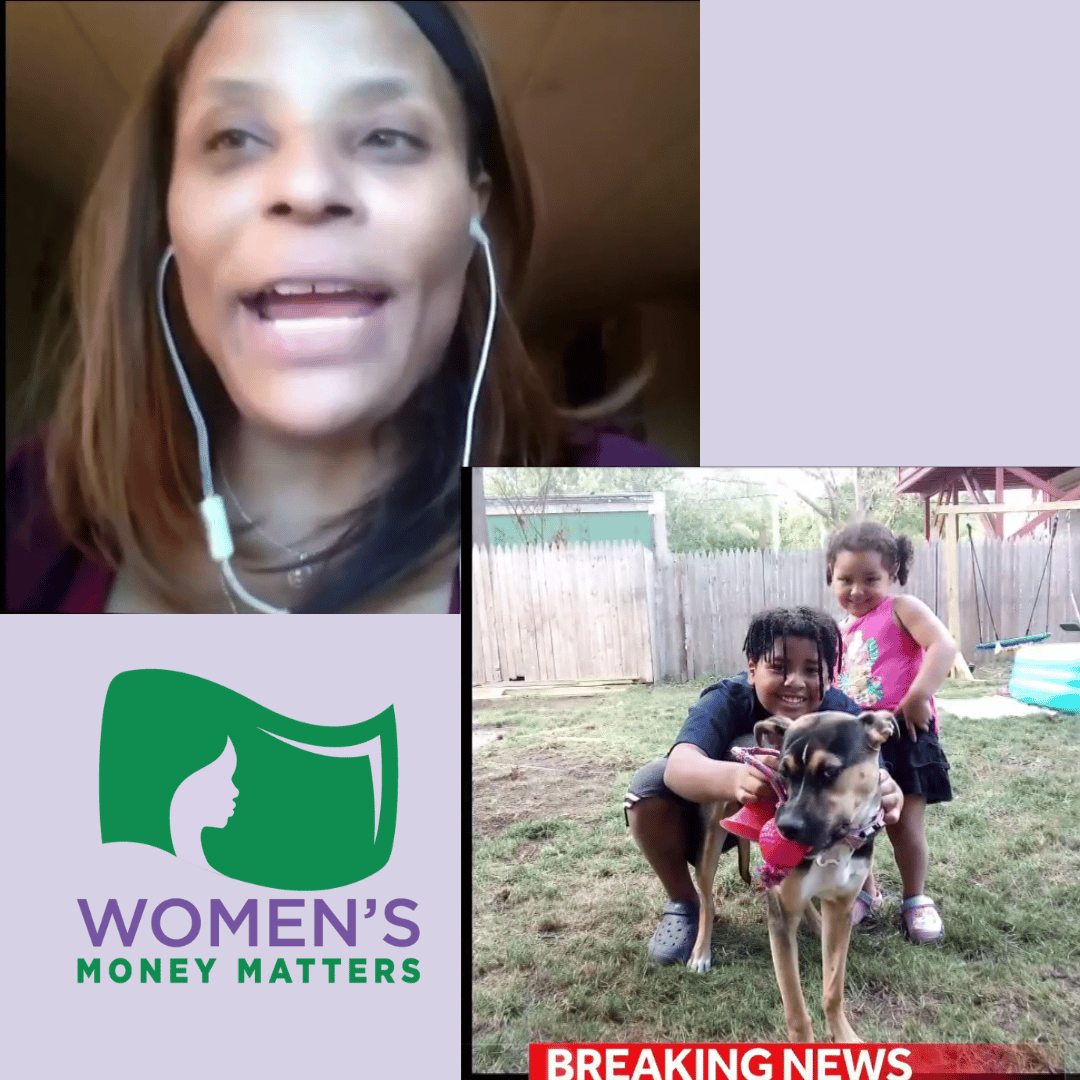
Deonne Lucaw spoke on the impact inflation has had on her finances. 

Women’s Money Matters, formerly Budget Buddies, which builds the financial wellness, confidence, and security of women living on low-incomes, connected program graduate Deonne Luacaw to NBC Nightly News with Lester Holt, bringing voice to the impact inflation is having on women living on low-incomes. Lucaw shared with NBC about the burden placed on her as a single mother providing for her children due to the increased cost of necessities like utilities. 

Lucaw shared “ We are hanging on by a thread. Instead of paying the whole light bill, I may have to put something down on it, so I can get my kids the other things they need.” 

Danielle Piskadlo, Executive Director of Women’s Money Matters said, “We appreciate Deonne’s willingness to share her experience to highlight how macroeconomic conditions and systemic inequalities are so often felt most by those living on the economic margins. In the course of our programs we hear so many women share similar experiences as they face these barriers and struggle with increasing prices and cost living.”

Women’s Money Matters provides financial wellness programs for women that include interactive expert-led workshops, one on one coaching from a trained volunteer, and small supportive peer cohorts. Women’s Money Matters connects participants to direct financial relief, community resources, and financial experts. 

Watch the NBC Spotlight here

# # #

About Women’s Money Matters:

Women’s Money Matters, formerly Budget Buddies, builds the financial wellness, confidence, and security of women living on low-incomes through a unique program that combines instructional workshops and personal, one-to-one coaching.

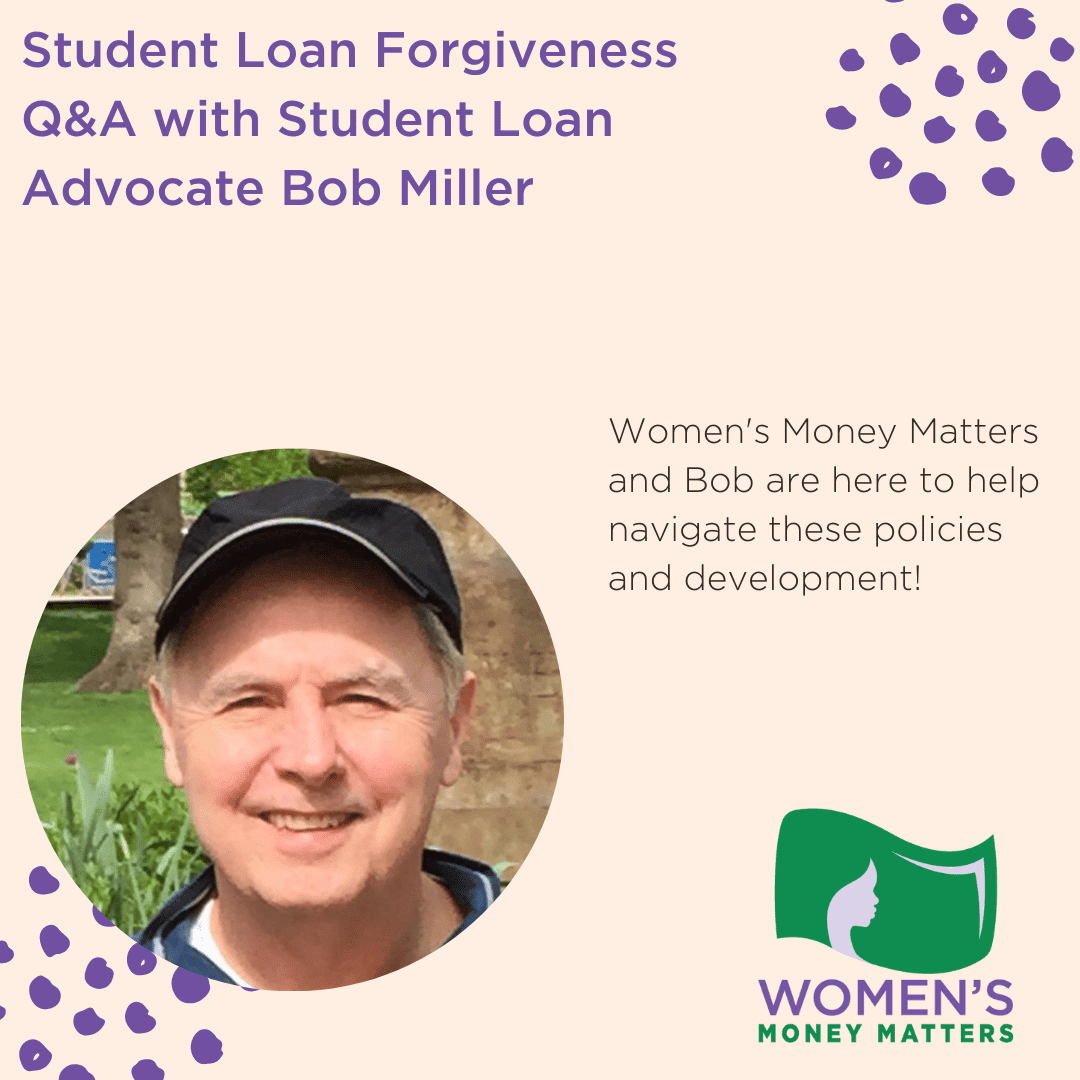
Student Loan Forgiveness Q&A with Student Loan Advocate Bob Miller

By Programs & Partnerships

Bob Miller is a long-time financial consultant and Women’s Money Matters Advisory Group member and we appreciate his time and expertise answering these student loan forgiveness FAQs.

How Student Loan Forgiveness Impacts You

According to the American Association of University Women, women hold the majority of student loan debt in the United States, totaling more than $900 billion. When they start school, women take on greater debt than their male counterparts, and when they graduate, are already faced with higher income gaps, creating even more disparity. 

Women’s Money Matters has heard from its participants over the years about the strain that student loan payments cause on their budgets. 

On August 25, President Biden announced a new student loan forgiveness initiative to assist Americans burdened by their mounting student loan debt. Women’s Money Matters spoke with our Advisory Group Member Bob Miller to dive into some of the details about the effects this initiative will have on individuals. 


What is the initiative that President Bident outlined and how do I know if I qualify? 

The forgiveness plan as proposed will eliminate $10,000 in student loan debt for individuals earning less than $125,000 per year (or $250,000 if you’re married and file jointly). 

If you’re a Pell Grant recipient, you may be eligible for an additional $10,000 loan forgiveness. If you are not sure if you received a Pell Grant, you can verify that you’re a Pell recipient by accessing the link: www.studentaid.gov and clicking on the section “My Aid.”

All loans must have been taken out prior to July 1, 2022 to qualify.


How will this impact my monthly payments? 

In the case of Income Driven Repayment Loans, or IDR Loans, monthly payments would be reduced to 5% from the current 10%, with any remaining balance forgiven after 20 years of payment. 


How can I make sure to take advantage of this initiative? 

The Department of Education should have access to your income data and automatically grant the loan forgiveness. If that doesn’t happen, you can visit the Department of Education’s loan website to submit a forgiveness application, which will be available in early October 2022. 


Do I need to start making payments on my loans in the meantime?
No, the current federal “payment pause” will be extended one final time to December 31, 2022. In the meantime, be sure to verify that all your contact information is up to date with your loan servicer using the Department of Education’s loan website.


What if I have private loans? 

You should look into refinancing options before the Fed raises its rates. 

Women’s Money Matters understands how confusing the student loan process can be and is available to offer support to all prior participants navigating this new development. You can reach out to us at info@womensmoneymatters.org

If you’re interested in learning more about financial wellness, please visit our website to learn more about the programs offered.

WBUR Highlights Women’s Money Matters Initiative

By In The News, Programs & Partnerships

Women’s Money Matters graduate Deonne shares with WBUR the financial planning skills she is utilizing from our financial wellness program to navigate this back to school season with two kids and high prices. “I had to start early, because the prices are so high,” Luacaw said. “You have to get the right deals at the right time.”

Women’s Money Matters recognizes the cost of living increases as a major challenge for women living on low-incomes, since the cost of everything from necessities to childcare to housing prices continue to increase. “According to federal data, prices were up about 7% in greater Boston in July compared to the same time last year.” 

Danielle Piskadlo, our Executive Director, shares in this article that many of our participants, “Lost wages during the pandemic, and their incomes still haven’t fully recovered and then on the heels of that, having the rising inflation and rising prices is just a whole new dynamic.” 

“We’re very cognizant of the fact that you cannot budget your way out of poverty,” Piskadlo said. “Larger barriers like the lack of housing or affordable child care… those do impact the women that are in our programs and their finances.”

In surveys our participants have cited rises in prices on utilities, gas, and groceries, as reasons making ends meet has been even more difficult than usual. 

Many thanks to Yasmin Amer for highlighting this important financial challenge that many women in our communities are facing as they work to give their kids the best back to school start possible. 

Read or listen to the article here: 

https://www.wbur.org/news/2022/09/06/education-inflation-money-budget-expensive


Women’s Money Matters Announces Partnerships with Direct Financial Relief Organizations

By Programs & Partnerships

Women’s Money Matters Announces Partnerships with Direct Financial Relief Organizations

Women experiencing unexpected financial hardships can now receive direct financial support  

Women’s Money Matters, formerly Budget Buddies, has been providing financial wellness, confidence and security to hundreds of women living on low-incomes for over a decade and began offering direct financial assistance to provide relief when many women lost income when the Covid pandemic hit. Now, the organization is excited to announce new partnerships with organizations to provide additional financial relief directly to women who are experiencing financial hardships.

Danielle Piskadlo, Executive Director of Women’s Money Matters shares “The responses we got when we reached out with emotional and financial support during Covid were heartbreaking – getting low on baby formula, going shopping with my last $60, 38 weeks pregnant with no income – and now, with inflation and prices rising, we’re beyond excited to have developed partnerships to allow us to offer continued financial support to the women in our programs – past and present!” 

The mission at Women’s Money Matters is to empower women on their financial wellness journey and assist them in planning for not only everyday living expenses but unexpected expenses as well. 

According to the Federal Reserve’s 2018 Survey of Household Economics and Decision Making, roughly 40% of Americans would struggle to come up with $400 to pay an unexpected bill. These large and unexpected expenses can derail an individual’s spending plan and cause women to go into further debt. 

Through its direct financial relief partners, currently including The Boston Bullpen Project, Bridge Forward Fund, and NeighborShare, Women’s Money Matters is able to help facilitate even more immediate relief to both current and past participants during challenging times to assist with emergency car payments, medical bills, rent, support leaving an abusive relationship, and more. 

“We are so proud to be partnered with Women’s Money Matters. Their operation and mission is a wonderful fit for Boston Bullpen Project,” said Steve Alperin, Founder of Boston Bullpen. “We look forward to years of working with them and providing assistance to their clients.”

Our partner organizations have made it their mission to assist individuals and families who are struggling to make ends meet, and we are grateful for their continued support. Past participants who are in need of direct financial assistance are encouraged to contact Women’s Money Matters for more information. 

“I want to thank you for helping me by paying my mortgage and rent for June 1st for me,” said Tabitha, a Women’s Money Matters Collective Program participant from New Hampshire who received relief through the partnership with Boston Bullpen. “It has also allowed me a few extra weeks of relief knowing I won’t be behind while waiting for assistance and next steps to go through. I can relax a tiny bit and take time with my kids and show them mom can relax and not stress every day.”

“If it wasn’t for [the relief donation] my husband would’ve had to miss work, I wouldn’t have been able to drive my kids to school and we wouldn’t have had enough for the rent,” said Elizabeth, a Women’s Money Matters participant who graduated in February from a program in Lowell and needed support for an unexpected car repair. “I know it doesn’t seem like much, but for us it was everything to receive that help.”

Women’s Money Matters is grateful for the support of its direct relief partners and looks forward to working with other organizations. If you are interested in partnering with Women’s Money Matters to provide assistance to women living on low-incomes, please visit our website

Women’s Money Matters Receives Project Innovation Grant from NBC

By In The News, Programs & Partnerships

BOSTON – Women’s Money Matters is honored to be recognized with a Project Innovation grant from NBC. The organization issued the below statement on being named as one of four Boston organizations that have made a positive impact in Massachusetts through an innovative solution:

“Women’s Money Matters is grateful for the support and recognition of our innovative and holistic approach to financial health for women living on low-incomes. Our model for financial wellness is one of the most successful strategies for disrupting poverty because of the unique combination of small peer support groups, a comprehensive series of financial wellness workshops tailored to the needs of women, and most importantly, the one-to-one coaching relationship.”

Women interested in joining a program can learn more here. Women looking to volunteer and serve as coaches and support women in their financial journey can sign up here.